Household Robots Market Size, Share & Growth Forecast 2026–2035
| Price : US $2800 | Date : Jan 2026 |
| CAT ID : 8 | Pages : 215 |
Heating, ventilation, and air conditioning (HVAC) systems play a crucial role in maintaining optimal operating conditions for data center infrastructure. As computing density rises and high-performance workloads such as AI training and machine learning consume more power, advanced cooling technologies are becoming essential for maintaining server reliability and operational efficiency.
Growing investments in hyperscale data centers, stricter energy efficiency regulations, and increasing adoption of liquid cooling technologies are key factors driving the expansion of the global data center HVAC industry.
Modern data centers generate significant amounts of heat due to the high concentration of servers, networking equipment, and storage infrastructure. Effective HVAC systems are essential to maintain temperature, humidity, and airflow within optimal ranges to prevent hardware failures and ensure consistent uptime.
Increasing demand for cloud computing services, digital transformation initiatives, and data-intensive technologies has accelerated the construction of hyperscale and colocation data centers globally. These facilities require advanced cooling systems capable of handling extremely high power densities while maintaining energy efficiency.
Additionally, environmental regulations and corporate sustainability commitments are encouraging operators to deploy eco-friendly HVAC technologies such as free cooling, evaporative cooling, and low-GWP refrigerants to reduce energy consumption and carbon emissions.
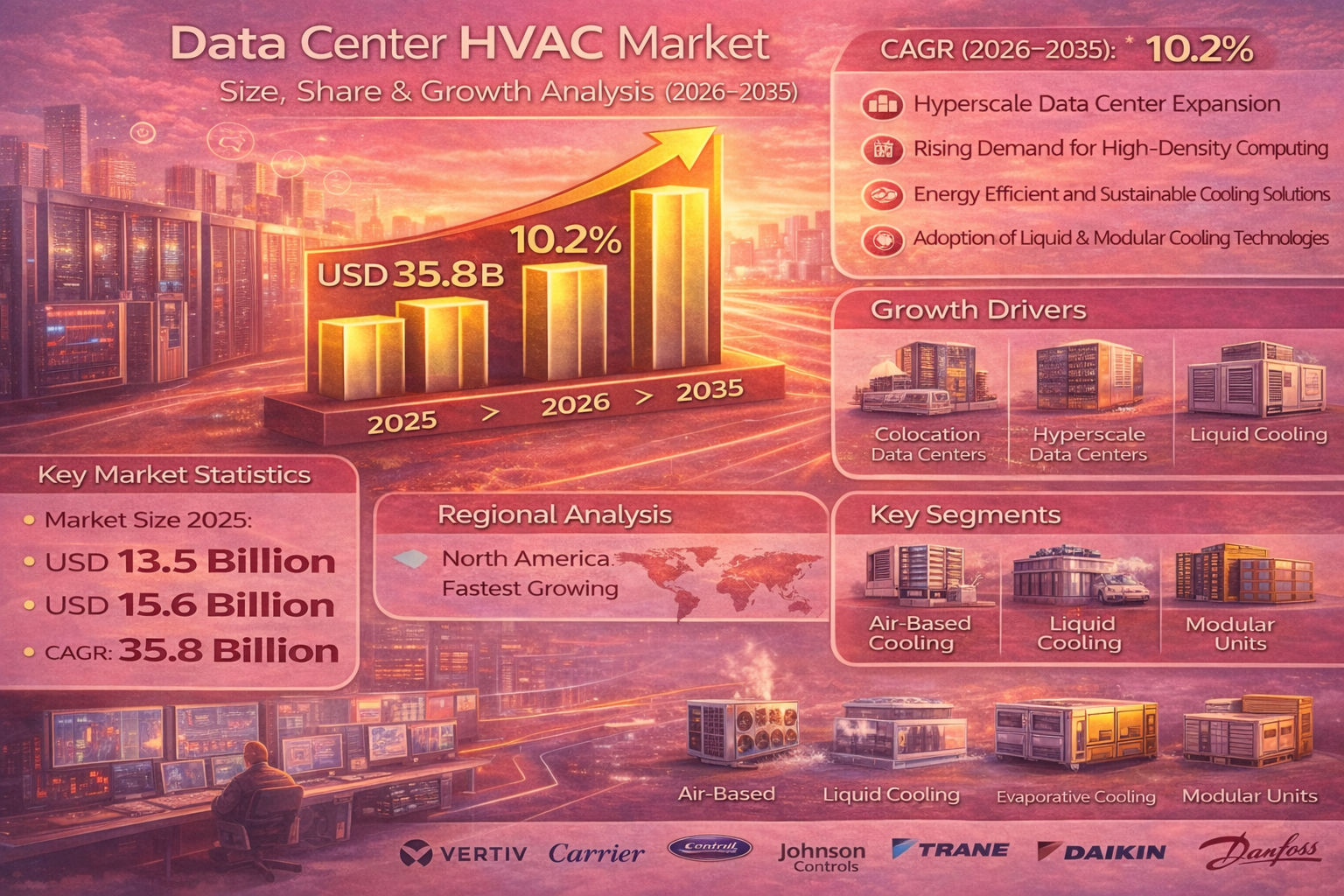
| Year | Market Size (USD Billion) |
|---|---|
| 2025 | 13.5 |
| 2026 | 15.6 |
| 2030 | 23.8 |
| 2035 | 35.8 |
One of the most notable trends in the industry is the increasing adoption of liquid cooling technologies, including direct-to-chip cooling and immersion cooling systems. These technologies provide superior heat transfer compared to conventional air cooling, making them ideal for high-density computing environments.
Another emerging trend is the development of modular cooling solutions that allow operators to scale cooling capacity as computing demand grows. Modular HVAC units can be deployed quickly and upgraded without disrupting existing operations.
Artificial intelligence and Internet of Things (IoT) technologies are also transforming HVAC operations by enabling predictive maintenance, real-time monitoring, and automated temperature control, thereby improving system reliability and reducing energy consumption.
HVAC solutions dominate the market due to the increasing need for advanced cooling infrastructure. These solutions include cooling systems, airflow management technologies, thermal monitoring systems, and energy optimization platforms designed to improve data center efficiency.
HVAC services such as consulting, installation, system integration, and maintenance are witnessing strong demand as operators seek specialized expertise to maintain optimal performance and regulatory compliance.
| Cooling Technology | Key Benefits |
|---|---|
| Air-Based Cooling | Widely adopted technology with lower installation complexity |
| Liquid Cooling | High efficiency for AI and high-density computing environments |
| Evaporative Cooling | Lower energy consumption and improved sustainability |
| Hybrid Cooling | Combines multiple cooling technologies for optimal efficiency |
Among these segments, hyperscale data centers represent the largest share due to the rapid expansion of cloud infrastructure operated by major technology companies.
The IT and telecommunications sector dominates the market due to rising cloud services demand and digital transformation across industries.
North America represents the largest market for data center HVAC systems due to the presence of major hyperscale data center operators and high investments in cloud infrastructure.
European countries are focusing on energy-efficient HVAC solutions to comply with strict environmental regulations and sustainability targets.
Asia Pacific is expected to witness the fastest growth due to rapid digitalization, increasing internet penetration, and expanding data center infrastructure across countries such as China, India, and Southeast Asia.
Emerging markets including Brazil, Mexico, UAE, and Saudi Arabia are investing heavily in data center development to support growing digital economies.
The global data center HVAC market is highly competitive with several technology providers offering innovative cooling solutions to support the rapidly evolving data center industry.
These companies are focusing on product innovation, strategic partnerships, and global expansion to strengthen their presence in the market.
The data center HVAC market is expected to grow steadily over the next decade as the demand for digital infrastructure continues to rise. Emerging technologies such as artificial intelligence, edge computing, and high-performance computing will further increase the need for advanced cooling systems.
Future developments are likely to focus on liquid cooling innovations, modular HVAC architectures, and energy-efficient thermal management solutions designed to reduce environmental impact while supporting next-generation computing infrastructure.
| Price : US $2800 | Date : Jan 2026 |
| CAT ID : 8 | Pages : 215 |
| Price : US $3200 | Date : Feb 2026 |
| CAT ID : 8 | Pages : 151 |
| Price : US $3200 | Date : Jan 2026 |
| CAT ID : 8 | Pages : 210 |
| Price : US $2800 | Date : Dec 2025 |
| CAT ID : 8 | Pages : 210 |
| Price : US $3200 | Date : Jan 2026 |
| CAT ID : 8 | Pages : 198 |
Customize this report to your needs — add regions, segments, or data points, with 20% free customization.
Customize This Report