
Market Research Report

Stationary Fuel Cell Market Size, Share & Growth Analysis by Technology, Application & End-Use Industry | Forecast 2025–2034

  • AMR ID : 1-10
  • CAT ID : 9
  • Pages : 204
  • Date : Nov 2025
 

Stationary Fuel Cell Market Size

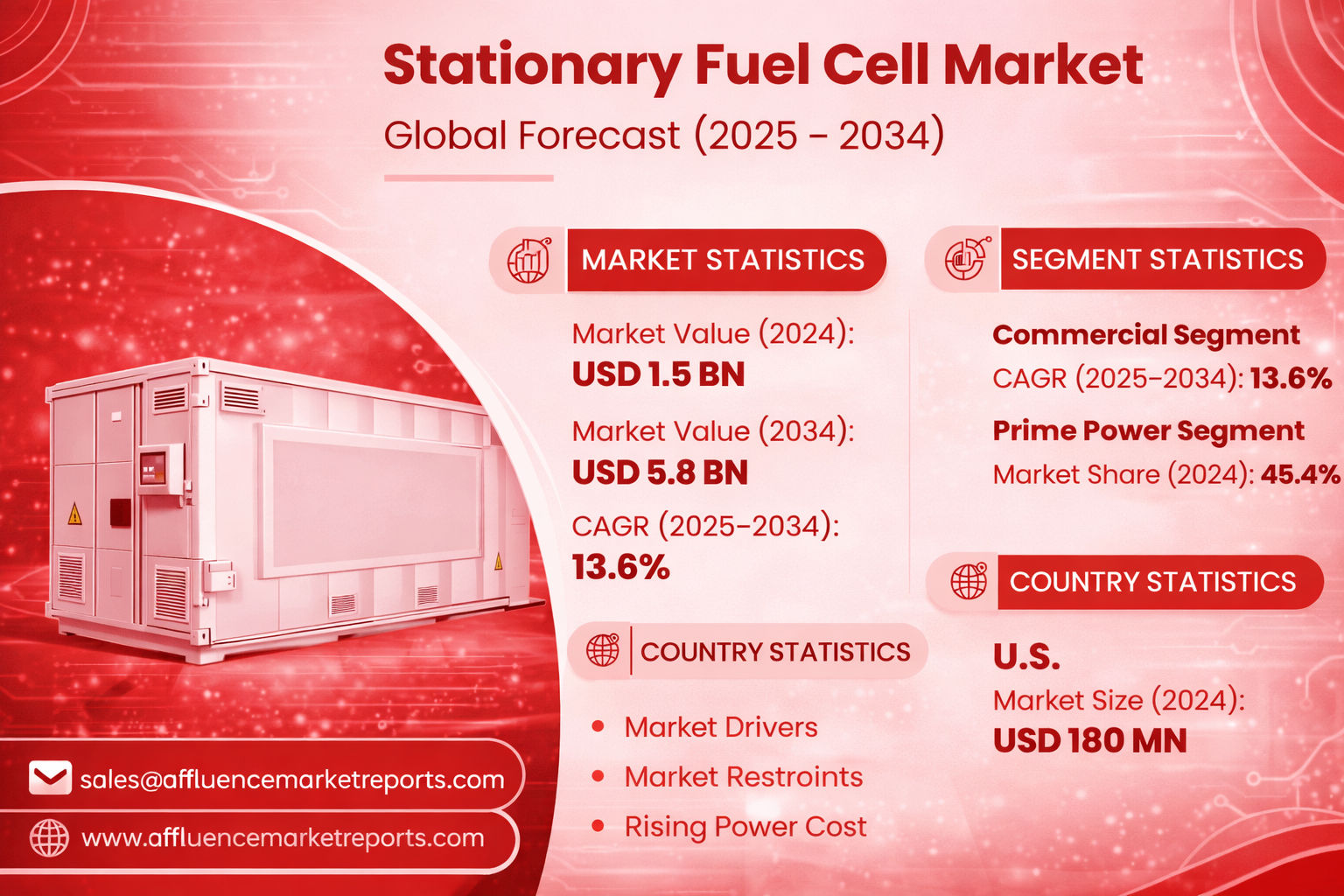
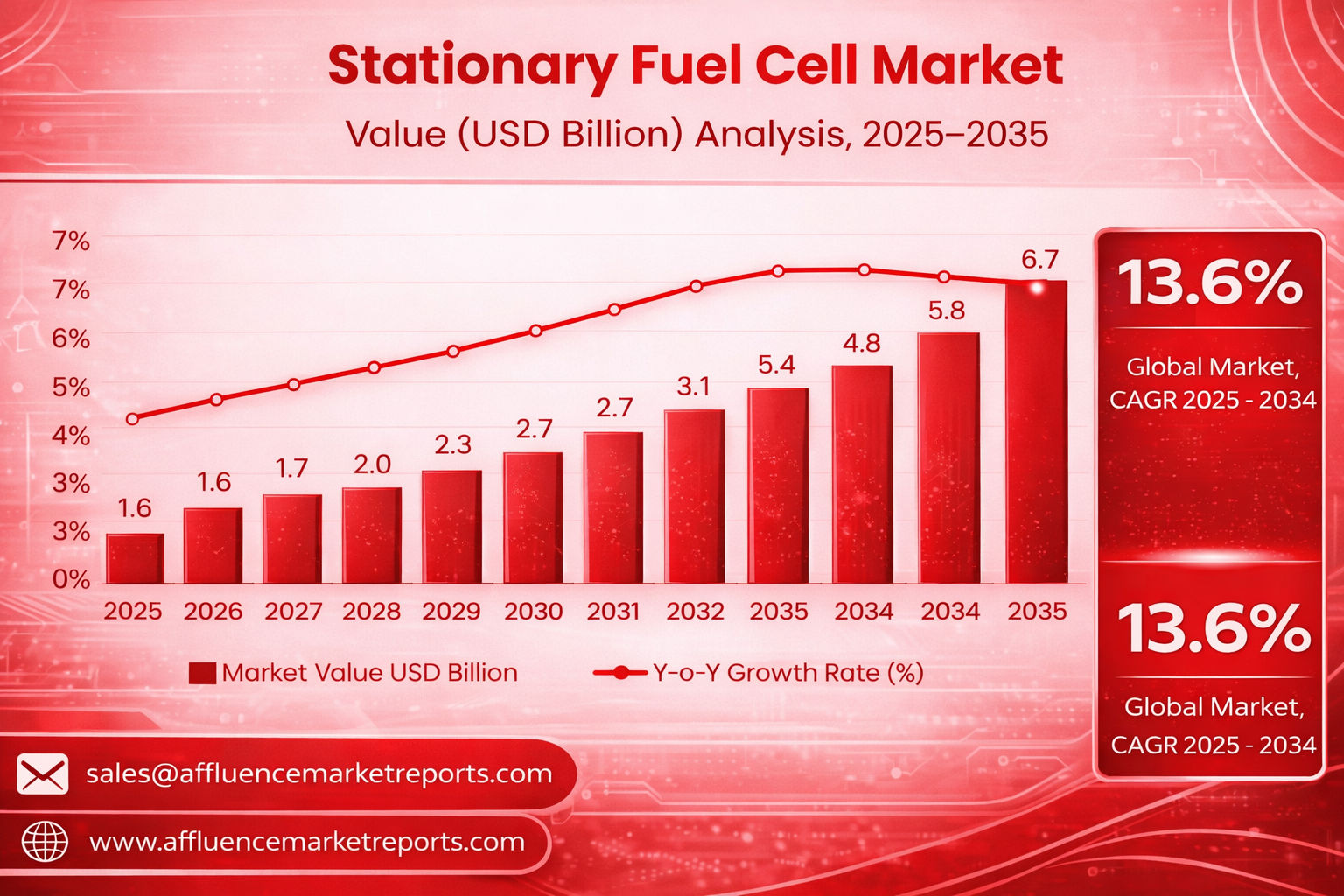
The global stationary fuel cell market was valued at USD 1.5 billion in 2024 and is projected to grow at a robust CAGR of 13.6% during the forecast period from 2025 to 2034, reaching approximately USD 5.8 billion by 2034. This report is published by Affluence Market Reports.

Stationary Fuel Cell Market Overview

The stationary fuel cell market is gaining significant momentum due to rising concerns over energy reliability, grid instability, and increasing demand for low-emission power generation systems. Growing power outages and aging grid infrastructure are accelerating the shift toward decentralized, on-site clean energy solutions across residential, commercial, and industrial sectors.

Stationary fuel cells offer high electrical efficiency, low carbon emissions, and reliable continuous power supply, making them viable alternatives to conventional diesel generators and battery-based backup systems. Their ability to support mission-critical infrastructure such as hospitals, data centers, utilities, and telecom facilities is driving widespread adoption.
Stationary Fuel Cell Market Report Attributes


  • Base Year: 2024

  • Market Size (2024): USD 1.5 Billion

  • Forecast Period: 2025 – 2034

  • CAGR (2025–2034): 13.6%

  • Market Size (2034): USD 5.8 Billion

Stationary Fuel Cell Market-Affluence Market Reports

Key Market Dynamics

Market Drivers


  • Growing investments in hydrogen economy development

  • Rising demand for uninterrupted power across critical infrastructure

  • Higher efficiency compared to conventional battery systems

  • Increasing adoption of clean and decentralized energy generation

Pitfalls & Challenges


  • Lack of hydrogen production and distribution infrastructure

  • High upfront cost of stationary fuel cell systems

Opportunities


  • Expansion of microgrids and distributed energy systems

  • Rising deployment in data centers and healthcare facilities

  • Government incentives for low-carbon and net-zero technologies

Stationary Fuel Cell Market Trends

Integration of stationary fuel cells with renewable energy sources is emerging as a key trend to enhance dispatchable and resilient power generation. Hydrogen fuel cell systems are increasingly being deployed alongside wind and solar projects to stabilize power output and ensure continuous supply.

Advancements in high-temperature proton exchange membrane (HT-PEM) and solid oxide fuel cell (SOFC) technologies are improving durability, efficiency, and scalability, enabling broader commercial and industrial adoption.

Stationary Fuel Cell Market Analysis

By End Use


  • Residential

  • Commercial

  • Industry / Utility

The commercial segment is expected to grow at a CAGR of approximately 13.9% during the forecast period, driven by sustainability targets and demand for dependable power solutions in hospitals, offices, and data infrastructure.

The residential segment is projected to surpass USD 2.2 billion by 2034, supported by rising awareness of energy independence and demand for compact, low-noise clean energy systems.

By Application


  • Prime Power

  • Combined Heat & Power (CHP)

  • Others

Prime power applications accounted for approximately 45.4% market share in 2024, owing to growing reliance on fuel cells for off-grid and remote power supply.
Stationary Fuel Cell Market | Affluence Market Reports

Regional Insights

North America

North America continues to be a key market, supported by federal investments in hydrogen and fuel cell R&D, strong policy support, and growing deployment across healthcare and data center applications.

Europe

Europe is witnessing steady growth driven by large-scale manufacturing initiatives, hydrogen infrastructure expansion, and decarbonization mandates across industrial and utility sectors.

Asia Pacific

Asia Pacific is projected to reach approximately USD 4.8 billion by 2034, fueled by rapid urbanization, industrial growth, and increasing adoption of clean energy technologies across China, India, Japan, and South Korea.

Competitive Landscape

The stationary fuel cell market is moderately consolidated, with leading players focusing on system efficiency improvements, capacity expansion, and integration with renewable and microgrid solutions. The top five companies collectively account for nearly 42.5% of total market revenue.

Key Companies


  • Bloom Energy

  • Ballard Power Systems

  • FuelCell Energy

  • Plug Power

  • Cummins

  • Siemens Energy

  • Doosan Fuel Cell

  • Toshiba Corporation

Future Outlook

The stationary fuel cell market is expected to witness sustained growth driven by hydrogen infrastructure expansion, increasing deployment in mission-critical applications, and global efforts to achieve net-zero emission targets. Continued technological advancements and policy support will further strengthen long-term market prospects.

Table of Contents


  • 1. Introduction


    • 1.1 Market Definition

    • 1.2 Scope of the Report

    • 1.3 Market Segmentation Overview

    • 1.4 Research Objectives


  • 2. Executive Summary

    • 2.1 Global Market Snapshot

    • 2.2 Key Growth Highlights

    • 2.3 Market Trends at a Glance

    • 2.4 Regional Performance Overview


  • 3. Stationary Fuel Cell Market Dynamics

    • 3.1 Market Drivers

    • 3.2 Market Restraints

    • 3.3 Market Opportunities

    • 3.4 Market Challenges

    • 3.5 Industry Value Chain Analysis


  • 4. Stationary Fuel Cell Market Trends

    • 4.1 Hydrogen Economy Developments

    • 4.2 Integration with Renewable Energy Systems

    • 4.3 Microgrid & Distributed Energy Trends

    • 4.4 Technological Advancements in Fuel Cells


  • 5. Market Size & Forecast Analysis

    • 5.1 Global Market Size (2020–2024)

    • 5.2 Global Market Forecast (2025–2034)

    • 5.3 Year-on-Year Growth Analysis

    • 5.4 CAGR Analysis


  • 6. Stationary Fuel Cell Market Analysis by End Use

    • 6.1 Residential

    • 6.2 Commercial

    • 6.3 Industrial

    • 6.4 Utility


  • 7. Stationary Fuel Cell Market Analysis by Application

    • 7.1 Prime Power

    • 7.2 Combined Heat & Power (CHP)

    • 7.3 Backup Power

    • 7.4 Other Applications


  • 8. Stationary Fuel Cell Market Analysis by Technology

    • 8.1 Proton Exchange Membrane Fuel Cell (PEMFC)

    • 8.2 Solid Oxide Fuel Cell (SOFC)

    • 8.3 Molten Carbonate Fuel Cell (MCFC)

    • 8.4 Phosphoric Acid Fuel Cell (PAFC)


  • 9. Regional Analysis

    • 9.1 North America

      • 9.1.1 United States

      • 9.1.2 Canada


    • 9.2 Europe

      • 9.2.1 Germany

      • 9.2.2 United Kingdom

      • 9.2.3 France

      • 9.2.4 Rest of Europe


    • 9.3 Asia Pacific

      • 9.3.1 China

      • 9.3.2 Japan

      • 9.3.3 South Korea

      • 9.3.4 India

      • 9.3.5 Rest of Asia Pacific


    • 9.4 Latin America

    • 9.5 Middle East & Africa


  • 10. Competitive Landscape

    • 10.1 Market Share Analysis

    • 10.2 Competitive Benchmarking

    • 10.3 Strategic Developments

    • 10.4 Mergers & Acquisitions

    • 10.5 Partnerships & Collaborations


  • 11. Company Profiles

    • 11.1 Bloom Energy

    • 11.2 Ballard Power Systems

    • 11.3 FuelCell Energy

    • 11.4 Plug Power

    • 11.5 Cummins

    • 11.6 Doosan Fuel Cell

    • 11.7 Toshiba Corporation

    • 11.8 Siemens Energy


  • 12. Investment & Opportunity Analysis

    • 12.1 Emerging Investment Hotspots

    • 12.2 R&D and Innovation Opportunities

    • 12.3 Government Policies & Incentives


  • 13. Future Outlook

    • 13.1 Market Growth Outlook

    • 13.2 Technology Roadmap

    • 13.3 Long-Term Industry Trends


  • 14. Research Methodology

    • 14.1 Primary Research

    • 14.2 Secondary Research

    • 14.3 Market Estimation Techniques

    • 14.4 Data Validation


Choose License Type

Single User : $1800


Corporate User : $3500


Why Choose Us ?
  • In-Depth Research
  • Competitive Analysis
  • Global Coverage
  • Verified Data Sources
  • 24/7 Research support

Frequently Asked Questions

The report efficiently evaluates the market from various dimensions to deliver an end-product that is informative, elaborate, and accurate and includes detailed market segmentation, regional analysis, and competitive landscape of the industry.
The report efficiently evaluates the current market size and provides industry forecast. The market was valued at xx Million US$ in 2019, and is expected to grow at a CAGR of xx% during the period 2020-2027.
The report efficiently evaluates the current market size and provides forecast for the industry in terms of Value (US$ Mn) and Volume (Thousands Units).
Market is segmented by Types, Applications, Technology, End-use Industries, and Regions.
The report presents the current market size, and market forecast, market opportunities, key drivers and restraints, regulatory scenario, industry trend, PESTLE analysis, PORTER’s analysis, new product approvals/launch, promotion and marketing initiatives, pricing analysis, competitive landscape which help businesses in decision making. The analysis data is based on current and historical market trends which help in investment related decisions.
Custom research is crucial components of the business strategy which helps any organization to gain insight into specific business sector, aligned with specific area of interest. Thus, SMI offers more accurate, pragmatic, and actionable information specifically tailored to suit your business needs.

Subscribe Newsletter

  Subscribe