
Pulsed Field Ablation Market Size, Share & Growth Forecast (2025–2034)
| Price : US $2800 | Date : Nov 2025 |
| CAT ID : 10 | Pages : 248 |
The global flow cytometry market was valued at approximately USD 4.65 billion in 2024 and is projected to reach nearly USD 7.05 billion by 2030, expanding at a steady CAGR of about 8.4% during the forecast period.
Flow cytometry has become a cornerstone technology across clinical diagnostics, biomedical research, drug discovery, and immunology. The market is primarily driven by the rising prevalence of cancer, autoimmune disorders, hematological diseases, and immunodeficiency conditions, along with growing investments in biotechnology and life science research.
Rapid technological evolution including spectral flow cytometry, automation, artificial intelligence (AI), and high-parameter cell analysis is further expanding the role of flow cytometry in precision medicine and translational research.
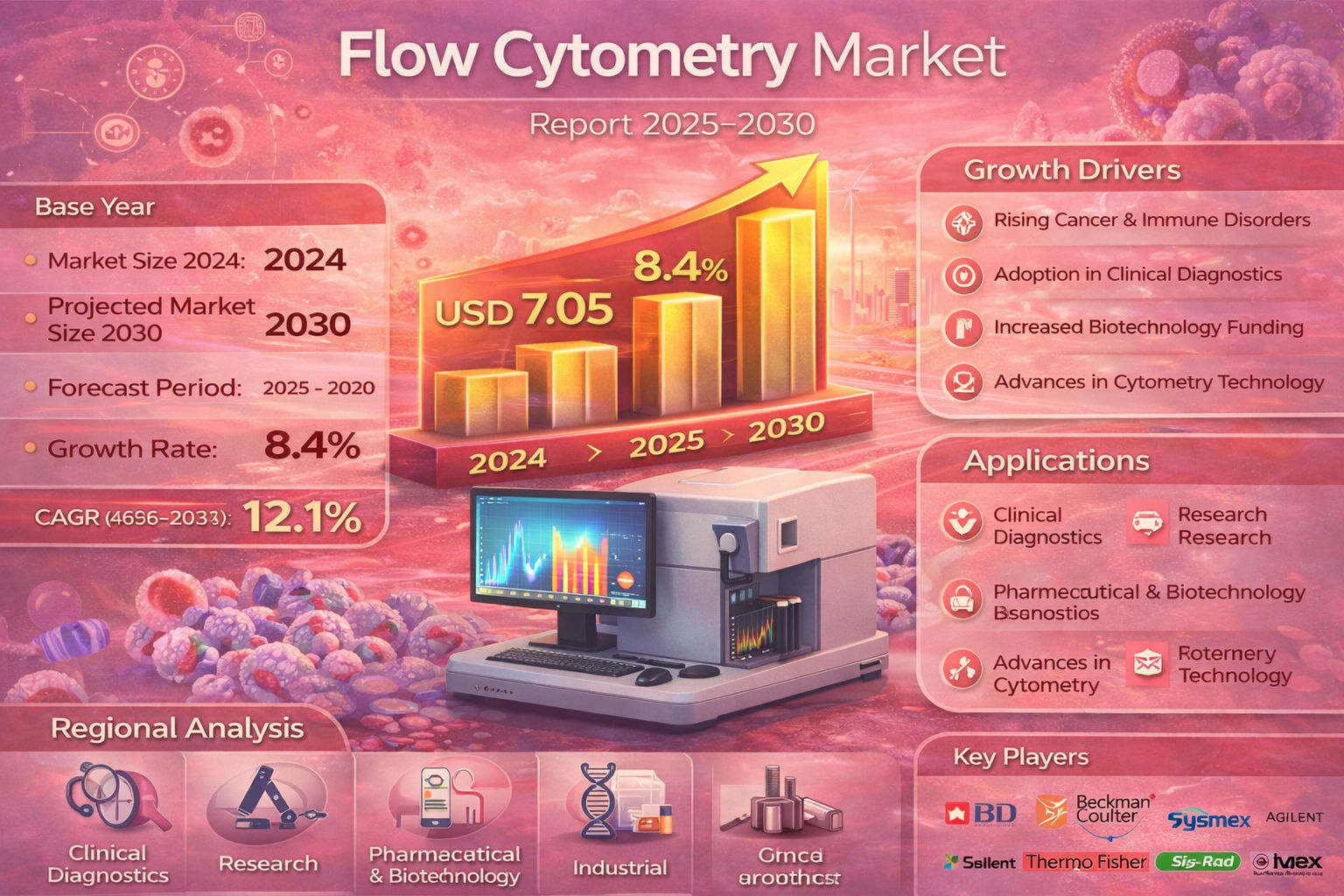
| Attribute | Details |
|---|---|
| Base Year | 2024 |
| Market Size (2024) | USD 4,650 Million |
| Projected Market Size (2030) | USD 7,050 Million |
| Forecast Period | 2025 – 2030 |
| Growth Rate | CAGR of 8.4% |
| Largest Region | North America |
Flow cytometry technology has witnessed rapid innovation over the past decade. The integration of spectral analysis allows simultaneous detection of over 40 parameters in a single run, improving resolution and data accuracy. AI-driven software platforms are enhancing data interpretation, workflow automation, and reproducibility.
Microfluidic flow cytometry, high-throughput cell sorting, and cloud-based data analytics are also gaining traction, enabling laboratories to process large sample volumes efficiently while reducing operational complexity.
By product category, flow cytometry instruments accounted for the largest market share in 2024, driven by continuous innovation in cell analyzers and cell sorters. Automated sample preparation systems and compact benchtop cytometers are improving accessibility across mid-sized laboratories.
The software segment is expected to grow at the fastest rate, supported by increasing demand for advanced analytics, regulatory-compliant data management, and AI-enabled interpretation tools in both research and clinical workflows.
Cell-based flow cytometry continues to dominate the market, accounting for more than three-quarters of total revenue in 2024. This technology is widely used in oncology, immunophenotyping, stem cell analysis, and immune monitoring.
Bead-based assays are gaining momentum due to their cost-effectiveness, multiplexing capabilities, and high suitability for infectious disease diagnostics and cytokine profiling.
The clinical application segment leads the market due to rising use of flow cytometry in oncology diagnostics, organ transplantation monitoring, and immune profiling.
Academic and research institutes represent the largest end-use segment, supported by continuous funding for life science research and increasing focus on cell-based studies. Clinical testing laboratories are expected to witness the fastest growth due to expanding diagnostic applications and outsourcing of specialized tests.
North America dominates the global flow cytometry market, supported by a mature healthcare infrastructure, strong presence of leading manufacturers, and high R&D spending in the U.S. and Canada.
Europe shows strong growth driven by biotechnology innovation, increasing adoption of automated cytometry, and expanding academic research programs in countries such as Germany, the UK, and France.
Asia Pacific is the fastest-growing regional market, fueled by rising healthcare expenditure, growing biopharmaceutical manufacturing, and increasing adoption of advanced diagnostics in China, India, and Japan.
The flow cytometry market is moderately consolidated, with leading players focusing on innovation, strategic acquisitions, automation, and expansion into emerging markets.
The flow cytometry market is expected to witness sustained growth through 2030, supported by technological innovation, rising disease burden, and increasing reliance on high-precision cellular analysis. Automation, AI integration, and expanding clinical adoption will continue to reshape the competitive landscape, making flow cytometry an essential tool in next-generation diagnostics and biomedical research.

| Price : US $2800 | Date : Nov 2025 |
| CAT ID : 10 | Pages : 248 |
| Price : US $2800 | Date : Oct 2025 |
| CAT ID : 10 | Pages : 155 |
| Price : US $2800 | Date : Dec 2025 |
| CAT ID : 10 | Pages : 220 |
| Price : US $2800 | Date : Nov 2025 |
| CAT ID : 10 | Pages : 202 |
| Price : US $2000 | Date : Dec 2025 |
| CAT ID : 10 | Pages : 210 |
Customize this report to your needs — add regions, segments, or data points, with 20% free customization.
Customize This Report