
CT Scanner Market Size
The global CT scanner market was valued at approximately USD 7.9 billion in 2024 and is expected to grow steadily, reaching nearly USD 14.6 billion by 2034, registering a CAGR of around 6.3% during the forecast period. This report is published by Affluence Market Reports.
CT Scanner Market Overview
The CT scanner market is witnessing sustained growth driven by the rising prevalence of chronic diseases, increasing demand for early and accurate diagnosis, and continuous technological advancements in medical imaging. Computed tomography systems are widely used across hospitals and diagnostic centers for fast, non-invasive visualization of internal organs.
Innovations such as high-slice CT scanners, AI-enabled image reconstruction, and low-dose radiation technologies are significantly improving diagnostic accuracy while reducing scan time and patient exposure. These advancements are accelerating adoption across emergency care, oncology, cardiology, and neurological diagnostics.
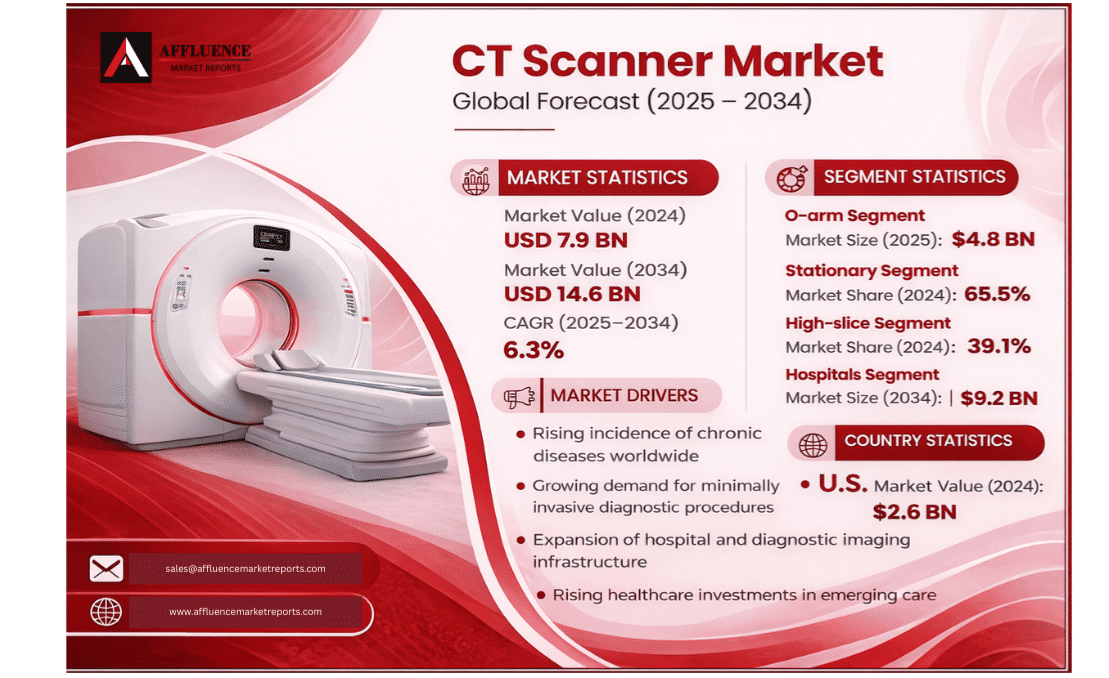
CT Scanner Market Report Attributes
- Base Year: 2024
- Market Size (2024): USD 7.9 Billion
- Forecast Period: 2025 – 2034
- CAGR (2025–2034): 6.3%
- Market Size (2034): USD 14.6 Billion

Key Market Dynamics
Market Drivers
- Rising incidence of cardiovascular, neurological, and oncological disorders
- Growing demand for rapid diagnostic imaging in emergency settings
- Technological advancements in high-slice and AI-powered CT scanners
- Expansion of hospital and diagnostic imaging infrastructure
Market Restraints
- High capital and maintenance costs of advanced CT systems
- Radiation exposure concerns among patients and healthcare providers
Market Opportunities
- Growing adoption of portable and compact CT scanners
- Rising healthcare investments in emerging economies
- Integration of AI and cloud-based imaging platforms
CT Scanner Market Trends
The market is increasingly shifting toward high-slice CT scanners capable of delivering faster scans with superior image clarity. Artificial intelligence is playing a critical role in enhancing image reconstruction, workflow automation, and clinical decision support.
Additionally, healthcare providers are prioritizing low-dose imaging technologies to minimize radiation exposure while maintaining diagnostic precision, supporting wider adoption across pediatric and preventive care.
CT Scanner Market Analysis
By Architecture
- O-arm CT Scanners
- C-arm CT Scanners
By Type
- Stationary CT Scanners
- Portable CT Scanners
By Technology
- Low-Slice CT Scanners
- Mid-Slice CT Scanners
- High-Slice CT Scanners
- Cone Beam CT Scanners
By Application
- Human Diagnostics
- Veterinary Imaging
- Research Applications
By End Use
- Hospitals
- Diagnostic Imaging Centers
- Contract Research Organizations (CROs)
Regional Insights
North America
North America dominates the CT scanner market due to advanced healthcare infrastructure, high adoption of cutting-edge imaging technologies, and strong presence of leading manufacturers.
Europe
Europe shows steady growth supported by increasing healthcare expenditure, strong regulatory frameworks, and rising demand for early disease diagnosis.
Asia Pacific
Asia Pacific is expected to witness the fastest growth, driven by expanding hospital networks, rising medical tourism, and growing investments in healthcare modernization across China, India, and Southeast Asia.
CT Scanner Market Key Players
- GE HealthCare
- Siemens Healthineers
- Koninklijke Philips N.V.
- Canon Medical Systems Corporation
- FUJIFILM Holdings Corporation
- Hitachi Medical Systems
- Samsung Medison
Competitive Landscape
The CT scanner market is highly competitive, with key players focusing on product innovation, AI integration, and strategic collaborations. Continuous investments in R&D and expansion into emerging markets remain key strategies for maintaining competitive advantage.
Future Outlook
The CT scanner market is expected to benefit from ongoing technological advancements, rising diagnostic demand, and increased healthcare spending worldwide. AI-powered imaging, portable CT solutions, and low-dose technologies will play a crucial role in shaping the future market landscape.

Table of Contents – CT Scanner Market
- 1. Introduction
- 1.1 Market Definition and Scope
- 1.2 Study Objectives
- 1.3 Market Segmentation Overview
- 1.4 Research Methodology Overview
- 2. Executive Summary
- 2.1 Global CT Scanner Market Snapshot
- 2.2 Key Growth Highlights
- 2.3 Market Size and Forecast Overview
- 2.4 Competitive Landscape Summary
- 3. CT Scanner Market Size & Forecast
- 3.1 Global Market Size (2021–2034)
- 3.2 Market Growth Rate (CAGR Analysis)
- 3.3 Revenue Forecast by Region
- 3.4 Key Market Assumptions
- 4. Market Dynamics
- 4.1 Growth Drivers
- 4.1.1 Rising Prevalence of Chronic Diseases
- 4.1.2 Growing Demand for Minimally Invasive Diagnostics
- 4.1.3 Technological Advancements in Imaging Systems
- 4.2 Market Restraints
- 4.2.1 High Installation and Maintenance Costs
- 4.2.2 Radiation Exposure Concerns
- 4.3 Market Opportunities
- 4.3.1 Expansion of Hospital Infrastructure
- 4.3.2 Adoption of AI-Enabled CT Imaging
- 4.3.3 Growth in Emerging Economies
- 4.4 Market Challenges
- 5. CT Scanner Market Trends
- 5.1 High-Slice CT Scanner Adoption
- 5.2 AI and Advanced Reconstruction Algorithms
- 5.3 Demand for Faster Imaging in Emergency Care
- 5.4 Shift Toward Low-Dose Imaging Technologies
- 6. Market Analysis by Architecture
- 6.1 O-arm CT Scanners
- 6.1.1 Market Size and Growth Outlook
- 6.1.2 Clinical Applications and Advantages
- 6.2 C-arm CT Scanners
- 6.2.1 Market Share Analysis
- 6.2.2 Technological Developments
- 7. Market Analysis by Type
- 7.1 Stationary CT Scanners
- 7.2 Portable CT Scanners
- 8. Market Analysis by Technology
- 8.1 High-Slice CT Scanners
- 8.2 Mid-Slice CT Scanners
- 8.3 Low-Slice CT Scanners
- 8.4 Cone Beam CT Scanners
- 9. Market Analysis by Application
- 9.1 Human Diagnostics
- 9.1.1 Oncology
- 9.1.2 Cardiology
- 9.1.3 Neurology
- 9.1.4 Other Diagnostic Applications
- 9.2 Research Applications
- 9.3 Veterinary Imaging
- 10. Market Analysis by End Use
- 10.1 Hospitals
- 10.2 Contract Research Organizations (CROs)
- 10.3 Ambulatory Surgical Centers
- 11. Regional Analysis
- 11.1 North America
- 11.1.1 United States
- 11.1.2 Canada
- 11.2 Europe
- 11.2.1 Germany
- 11.2.2 United Kingdom
- 11.2.3 France
- 11.2.4 Italy
- 11.2.5 Rest of Europe
- 11.3 Asia Pacific
- 11.3.1 China
- 11.3.2 Japan
- 11.3.3 India
- 11.3.4 South Korea
- 11.3.5 Rest of Asia Pacific
- 11.4 Latin America
- 11.5 Middle East & Africa
- 12. Competitive Landscape
- 12.1 Market Share Analysis
- 12.2 Strategic Developments
- 12.3 Product Launches and Innovations
- 12.4 Mergers, Acquisitions, and Partnerships
- 13. Key Companies Profiled
- 13.1 Company Overview
- 13.2 Product Portfolio
- 13.3 Financial Overview
- 13.4 Strategic Initiatives
- 14. Industry Developments & News
- 15. Analyst Viewpoint & Strategic Recommendations
- 16. Appendix
- 16.1 List of Abbreviations
- 16.2 Assumptions and Limitations
- 16.3 Contact Information
| Price : US $1800 |
Date : Oct 2025 |
| CAT ID : 10 |
Pages : 155 |
View Report
| Price : US $1800 |
Date : Dec 2025 |
| CAT ID : 10 |
Pages : 220 |
View Report
| Price : US $1800 |
Date : Nov 2025 |
| CAT ID : 10 |
Pages : 202 |
View Report