
Automotive Radar-on-Chip Technology Market Size
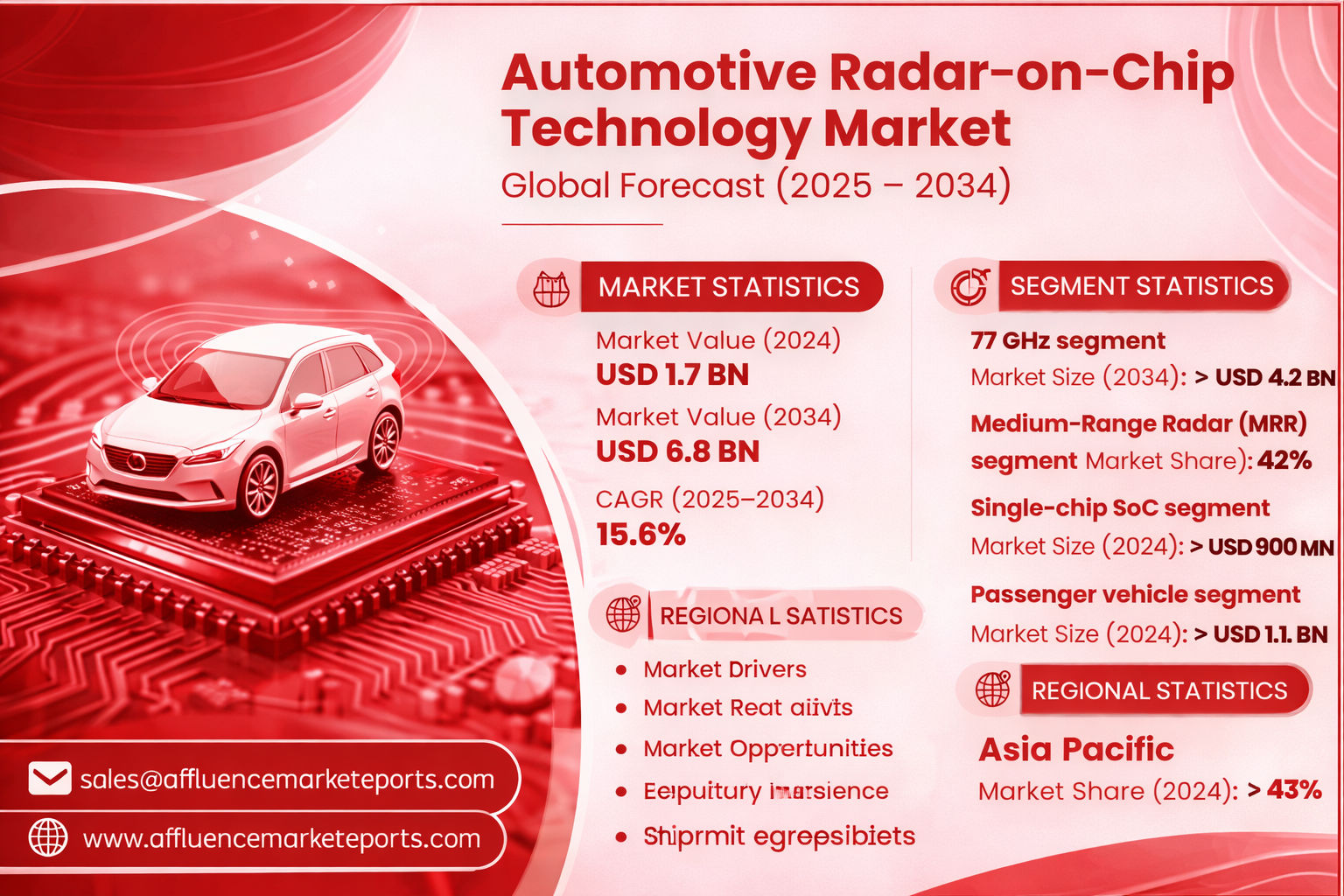
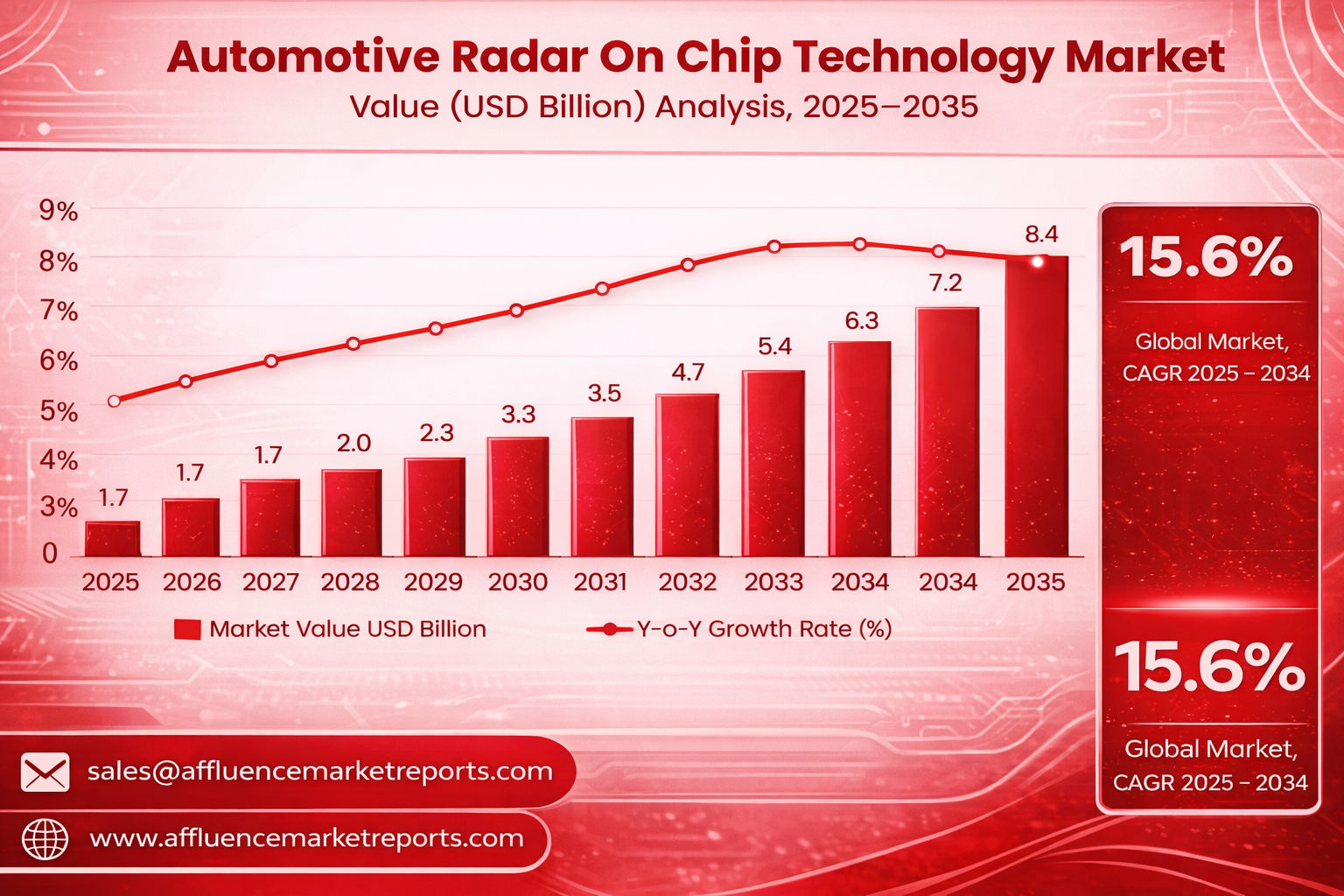
The global automotive radar-on-chip (RoC) technology market was valued at approximately USD 1.7 billion in 2024 and is expected to grow at a robust pace, reaching nearly USD 6.8 billion by 2034. The market is anticipated to expand at a strong CAGR of around 15.6% during the forecast period. This report is published by Affluence Market Reports.
Market Overview
Automotive radar-on-chip technology integrates radar transceivers, antennas, and signal processing components into a single semiconductor chip, enabling compact, energy-efficient, and high-performance radar sensing solutions. These systems are increasingly adopted in modern vehicles to support advanced driver assistance systems (ADAS) and autonomous driving functions.
The growing penetration of electric vehicles, rising safety regulations, and increasing demand for scalable sensor architectures are accelerating the adoption of radar-on-chip platforms across passenger and commercial vehicles.
Market Report Attributes
- Base Year: 2024
- Market Size (2024): USD 1.7 Billion
- Forecast Period: 2025 – 2034
- CAGR (2025–2034): 15.6%
- Market Size (2034): USD 6.8 Billion

Key Market Dynamics
Market Drivers
- Rapid adoption of ADAS and semi-autonomous driving technologies
- Increasing safety mandates and NCAP regulations worldwide
- Rising electric vehicle production and zonal vehicle architectures
- Advancements in mmWave CMOS and RF-CMOS semiconductor technologies
Market Restraints
- High research and development costs for radar chip design
- Complex calibration and validation requirements
Market Opportunities
- Integration of AI-enabled and software-defined radar systems
- Growing adoption of 4D imaging radar as an alternative to LiDAR
- Expansion of ADAS features in mid-range and entry-level vehicles
Market Trends
A key trend shaping the market is the integration of 4D imaging radar capabilities directly into radar-on-chip solutions. These systems provide enhanced object detection, improved angular resolution, and superior performance in adverse weather conditions.
Additionally, AI-powered edge processing and sensor fusion are transforming radar platforms into software-upgradable perception systems, extending product lifecycle and improving adaptability for autonomous driving applications.
Market Segmentation Analysis
By Frequency Band
The 77 GHz segment dominates the market due to its superior resolution and widespread adoption in long-range radar applications such as adaptive cruise control and collision avoidance.
By Range
- Short-Range Radar (SRR)
- Medium-Range Radar (MRR)
- Long-Range Radar (LRR)
By Technology
- Single-Chip SoC
- Multi-Chip Modules
- Integrated Radar Arrays
Single-chip SoC solutions lead the market due to reduced power consumption, lower bill of materials, and simplified system integration.
By Vehicle Type
- Passenger Vehicles (Hatchback, Sedan, SUV)
- Commercial Vehicles (LCV, MCV, HCV)
By Application
- Adaptive Cruise Control (ACC)
- Blind Spot Detection (BSD)
- Automatic Emergency Braking (AEB)
- Forward Collision Warning (FCW)
- Advanced Parking Assistance
- Corner Radar for Autonomous Vehicles

Regional Insights
Asia Pacific
Asia Pacific holds the largest market share, supported by high vehicle production volumes, rapid ADAS adoption, and strong government initiatives promoting intelligent mobility solutions.
North America
North America exhibits strong growth driven by safety regulations, technological innovation, and increasing deployment of radar-based perception systems in electric and autonomous vehicles.
Europe
Europe continues to benefit from strict vehicle safety regulations, strong presence of automotive OEMs, and increasing investments in autonomous driving research and development.
Key Players
- Robert Bosch GmbH
- Continental AG
- Valeo
- NXP Semiconductors
- Infineon Technologies
- Texas Instruments
- ZF Friedrichshafen AG
Future Outlook
The automotive radar-on-chip technology market is expected to witness significant innovation driven by AI-based perception, 4D radar imaging, and increased integration with vehicle domain controllers. Continued regulatory support and demand for enhanced vehicle safety will further strengthen long-term market growth.

Table of Contents
- 1. Automotive Radar-on-Chip Technology Market Overview
- 1.1 Market Definition and Scope
- 1.2 Radar-on-Chip Technology Overview
- 1.3 Market Ecosystem Analysis
- 1.4 Industry Value Chain Analysis
- 1.5 Market Evolution and Technology Roadmap
- 2. Executive Summary
- 2.1 Global Market Snapshot
- 2.2 Key Growth Highlights
- 2.3 Market Revenue Trends
- 2.4 Regional Market Summary
- 2.5 Key Strategic Insights
- 3. Automotive Radar-on-Chip Technology Market Size and Forecast
- 3.1 Global Market Size, 2020–2024
- 3.2 Global Market Forecast, 2025–2034
- 3.3 Year-on-Year Growth Analysis
- 3.4 Market Growth Rate Analysis (CAGR)
- 3.5 Market Attractiveness Index
- 4. Market Dynamics Analysis
- 4.1 Market Drivers
- 4.2 Market Restraints
- 4.3 Market Opportunities
- 4.4 Market Challenges
- 4.5 Regulatory and Safety Standards Overview
- 5. Technology Landscape
- 5.1 Radar Signal Processing Technologies
- 5.2 RF-CMOS and mmWave Semiconductor Advancements
- 5.3 AI-Enabled Radar Processing
- 5.4 4D Imaging Radar Developments
- 5.5 Comparison with LiDAR and Camera-Based Systems
- 6. Market Segmentation Analysis – By Frequency Band
- 6.1 24 GHz Radar-on-Chip Market
- 6.2 77 GHz Radar-on-Chip Market
- 6.3 79 GHz Radar-on-Chip Market
- 7. Market Segmentation Analysis – By Range
- 7.1 Short-Range Radar (SRR)
- 7.2 Medium-Range Radar (MRR)
- 7.3 Long-Range Radar (LRR)
- 8. Market Segmentation Analysis – By Technology Type
- 8.1 Single-Chip System-on-Chip (SoC)
- 8.2 Multi-Chip Modules
- 8.3 Integrated Radar Arrays
- 9. Market Segmentation Analysis – By Vehicle Type
- 9.1 Passenger Vehicles
- 9.2 Light Commercial Vehicles
- 9.3 Medium and Heavy Commercial Vehicles
- 10. Market Segmentation Analysis – By Application
- 10.1 Adaptive Cruise Control (ACC)
- 10.2 Blind Spot Detection (BSD)
- 10.3 Automatic Emergency Braking (AEB)
- 10.4 Forward Collision Warning (FCW)
- 10.5 Parking Assistance Systems
- 10.6 Autonomous Driving and Corner Radar
- 11. Regional Analysis
- 11.1 North America Market Analysis
- 11.1.1 United States
- 11.1.2 Canada
- 11.2 Europe Market Analysis
- 11.2.1 Germany
- 11.2.2 France
- 11.2.3 United Kingdom
- 11.2.4 Rest of Europe
- 11.3 Asia Pacific Market Analysis
- 11.3.1 China
- 11.3.2 Japan
- 11.3.3 India
- 11.3.4 South Korea
- 11.3.5 Rest of Asia Pacific
- 11.4 Latin America Market Analysis
- 11.5 Middle East & Africa Market Analysis
- 12. Competitive Landscape
- 12.1 Market Share Analysis
- 12.2 Competitive Benchmarking
- 12.3 Strategic Initiatives and Partnerships
- 12.4 Mergers and Acquisitions
- 12.5 New Product Launches
- 13. Key Players Profiles
- 13.1 Robert Bosch GmbH
- 13.2 Continental AG
- 13.3 Valeo
- 13.4 NXP Semiconductors
- 13.5 Infineon Technologies
- 13.6 Texas Instruments
- 13.7 ZF Friedrichshafen AG
- 14. Investment and Growth Opportunities
- 15. Analyst Insights and Strategic Recommendations
- 16. Research Methodology
- 16.1 Primary Research
- 16.2 Secondary Research
- 16.3 Market Estimation Techniques
- 16.4 Forecasting Assumptions
- 16.5 Data Validation and Triangulation
- 17. Appendix
- 17.1 Abbreviations
- 17.2 Definitions
| Price : US $1800 |
Date : Sep 2025 |
| CAT ID : 5 |
Pages : 180 |
View Report